
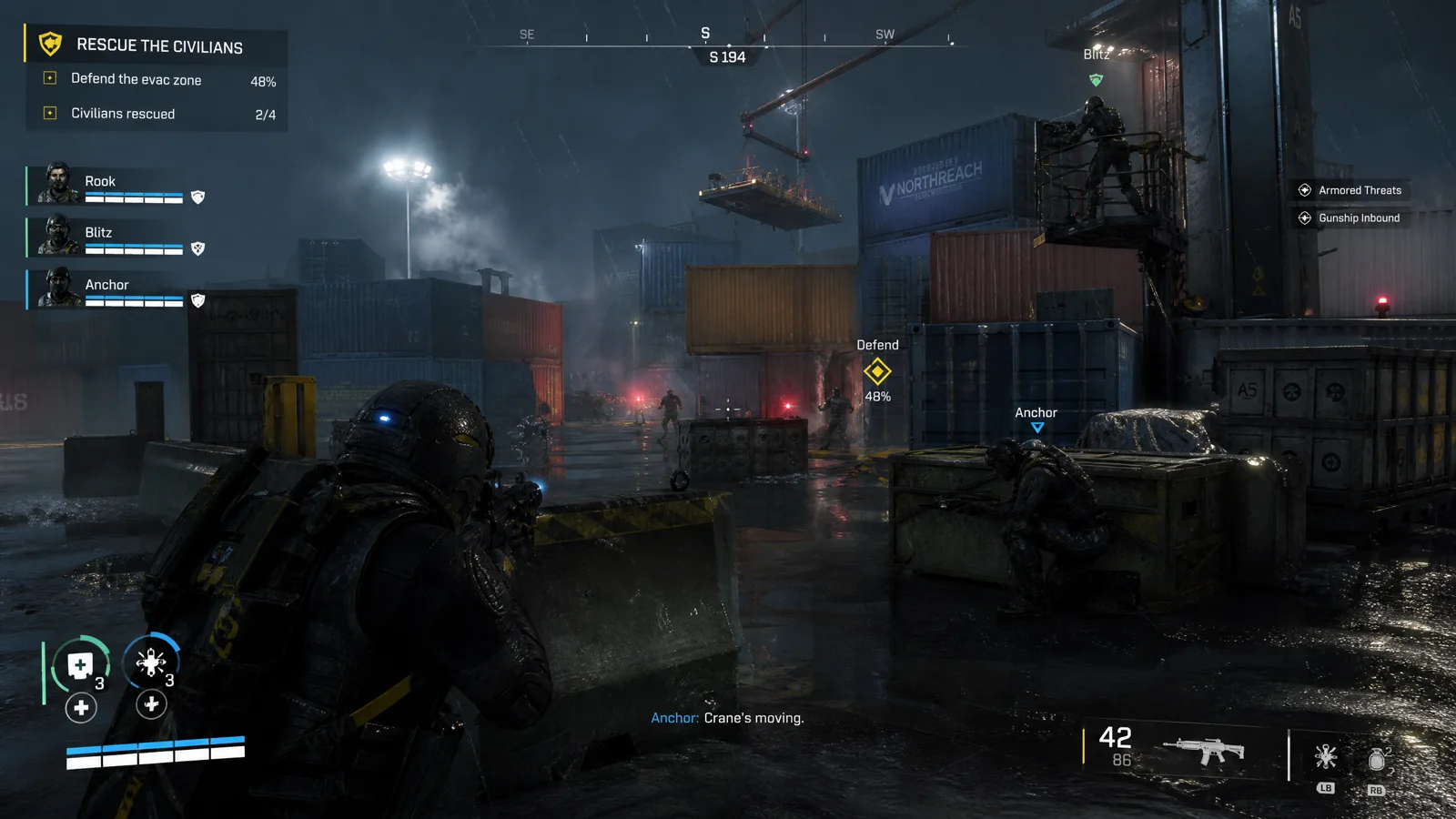
Cooperative shooters often fall into the trap of letting one skilled player carry the entire team, transforming what should be a tactical operation into a chaotic sprint for the highest kill count. Breakwater Nine, an upcoming tactical defence shooter, aggressively dismantles this lone-wolf mentality. Set against the bleak, rain-soaked backdrop of an industrial shipping yard, this four-player experience demands that squads actually work together to survive the night. By enforcing class roles and emphasising environmental problem-solving over raw firepower, it delivers a punishing take on cooperative survival where communication is your most valuable weapon.
Surviving the Graveyard Shift
The core loop of Breakwater Nine revolves around defending a sprawling container harbour against relentless waves of hostile forces while simultaneously completing critical rescue objectives. Unlike traditional horde shooters where you can bunker down in a single defensible corner, the game forces you to remain mobile. The rain-slicked asphalt of the harbour is vast, and the extraction points for the stranded dockworkers you are trying to save are constantly shifting. You have to push out into the storm, secure the civilians, and escort them back to reinforced holding zones before the next wave crashes into your position.
What makes this loop engaging is how heavily it relies on asymmetrical squad responsibilities. You cannot just pick four assault rifles and hope for the best. The game restricts loadouts based on four distinct class roles, meaning every player brings something vital to the table. The heavy weapons specialist might hold down a chokepoint, but they are entirely reliant on the scout to ping approaching threats through the torrential downpour. It is hard yakka, and the punishing difficulty ensures that a squad that fails to coordinate will be swiftly overwhelmed.
Tools of the Trade
Mechanically, Breakwater Nine introduces several layers of interactivity that elevate it above standard run-and-gun affairs. The most prominent is the movable cover system. The harbour is littered with shipping crates, forklifts, and concrete barricades that can be physically pushed or towed into new positions. Setting up a robust defensive perimeter before an assault begins is just as important as your accuracy during the firefight. Moving these heavy objects leaves players completely exposed, necessitating covering fire from the rest of the squad.
Further complicating matters is the inclusion of environmental machinery, most notably the towering gantry cranes. One player can ascend to the control cabin to manipulate massive shipping containers, dropping them to crush grouped enemies or creating impenetrable walls to block flanking routes. The controls for the crane are deliberately cumbersome, simulating the heavy machinery's immense weight, meaning the operator needs constant updates from the ground team. To facilitate this, the game features a robust communication ping system. With limited ammunition scattered sparsely across the map, players must use these pings to highlight supply drops, call out targets, and coordinate crane strikes without clogging up voice comms.
A Harbour in the Storm
The mission design is intrinsically tied to the geography of the harbour itself. The developers have crafted a space that feels like a genuine industrial site rather than a series of artificial combat arenas. The layout is a maze of towering steel corridors, open loading bays, and treacherous catwalks. The verticality of the environment plays a crucial role. Snipers can take up positions on top of the stacked containers, but the slick surfaces and driving rain make these vantage points perilous. A single misstep can send a player plummeting to the tarmac below, requiring an immediate rescue operation.
The dynamic weather system is not just for show; it fundamentally alters how you navigate the space. Heavy downpours reduce visibility to a few metres, forcing squads to rely heavily on their flashlights and the scout's motion sensors. Puddles form in low-lying areas, slowing movement and making a hasty retreat significantly more difficult. The rescue objectives are thoughtfully integrated into this hostile environment. You might have to breach a locked customs office to free trapped workers, or hold the line at the end of a long, exposed pier while a rescue boat makes its slow approach.
Atmospheric Tension
Visually, Breakwater Nine is a striking exercise in atmospheric dread. The night-time setting is illuminated only by the harsh glare of industrial floodlights and the erratic flashes of muzzle fire. The rain effects are particularly impressive, with water sheeting off the metal containers and pooling realistically on the ground. The character models are heavily geared, covered in tactical webbing and rain slickers that look genuinely sodden by the end of a match. It is a bleak, oppressive aesthetic that perfectly complements the desperate nature of the gameplay.
The audio design is equally crucial to the game's oppressive atmosphere. The constant drumming of rain on metal provides a deafening baseline that threatens to drown out the subtler audio cues you need to survive. The sharp crack of incoming sniper fire cuts through the ambient noise with terrifying clarity, while the heavy, metallic groan of the gantry crane shifting overhead is both reassuring and ominous. The localized voice chat system degrades as players move further apart, simulating the interference of the storm and forcing squads to stick close together.
Strengths and Weaknesses
There is a lot to admire in how strictly Breakwater Nine adheres to its cooperative vision. The interlocking class abilities and the emphasis on environmental control create a deeply satisfying tactical puzzle. However, there are areas where the execution currently falls a bit short.
- The Good: The movable cover system fundamentally changes how you approach defensive setups, allowing for genuine creativity.
- The Good: The integration of the gantry crane as a player-controlled weapon is brilliant, requiring immense coordination.
- The Good: The ping system is comprehensive and intuitive, allowing even matchmade squads to communicate effectively.
- The Bad: Ammunition scarcity, while intended to force careful shot placement, sometimes feels overly punishing.
- The Bad: The pathfinding for the rescued dockworkers can occasionally bug out, causing them to get stuck on environmental geometry.
A Promising Shift
Even in its current preview state, Breakwater Nine is shaping up to be a formidable entry in the cooperative shooter space. By stripping away the ability for a single player to dominate the battlefield, it forces a level of camaraderie and tactical planning that is rare in the genre. The rain-soaked harbour is a masterclass in atmospheric level design, providing a grim, believable backdrop for the desperate defensive stands. The reliance on class roles, movable cover, and heavy machinery ensures that every firefight is a puzzle that needs to be solved collectively.
While the punishing ammunition economy and occasional AI pathfinding issues need to be ironed out before the final release, the foundation here is exceptionally strong. It is a game that understands the true appeal of cooperative play: the shared panic when a plan falls apart, and the immense satisfaction when a squad pulls together to drag themselves back from the brink.