
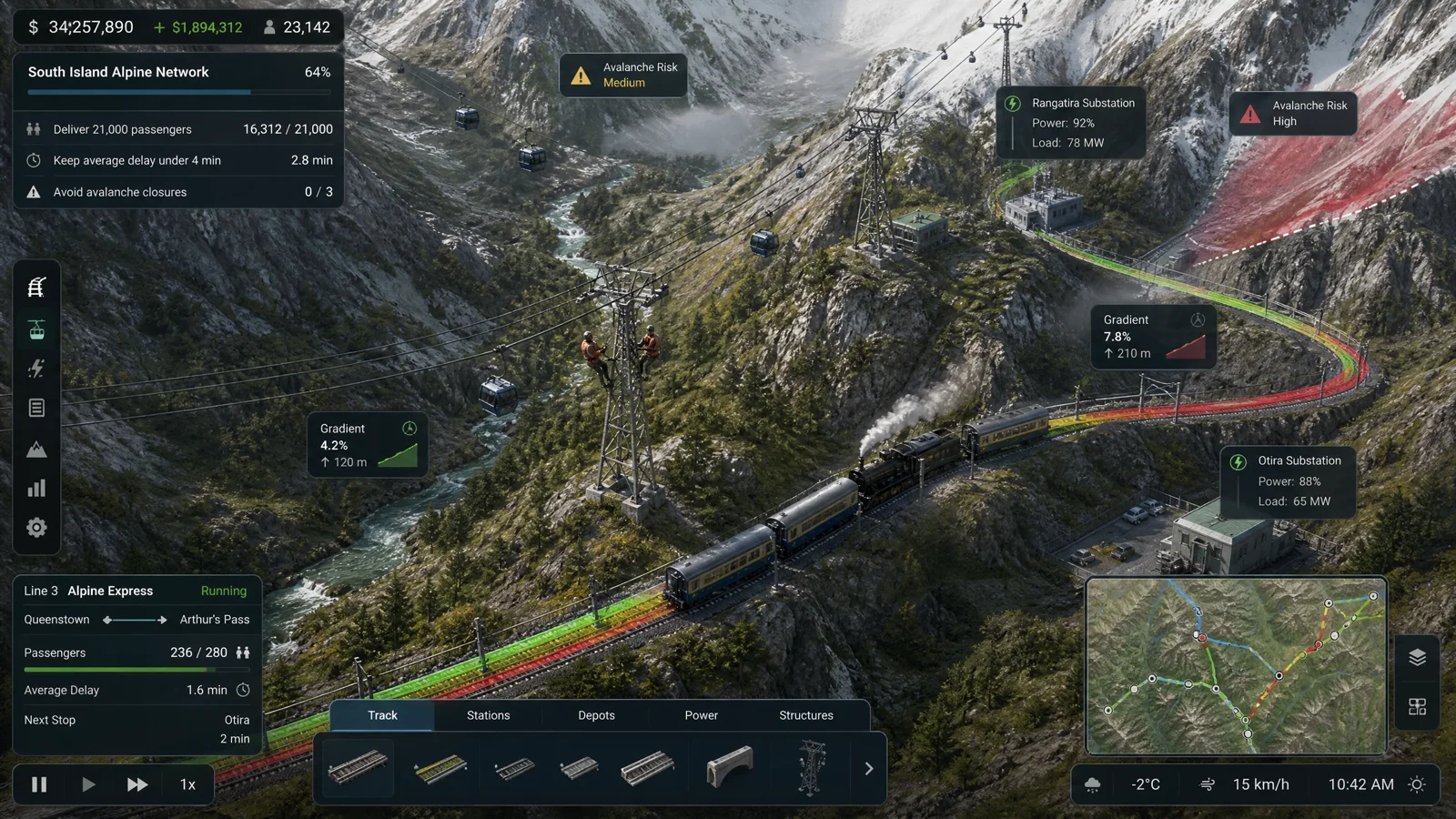
If you have ever stared up at the Southern Alps and thought it could use a bit more steel and cable, Skyrail Aotearoa is here to answer your oddly specific prayers. It is a game where laying down tracks is only half the battle; keeping them running when a southerly blasts through is the real hard yakka. In this guide, we are going to walk you through the crucial first three hours of this isometric management sim, explaining why building a network that actually survives winter is heaps better than slapping down a spectacular but doomed shortcut across the nearest gorge.
The Core Loop: Getting Off the Ground
The first few hours of Skyrail Aotearoa can feel like a baptism by fire, or rather, by frost. Your primary objective is to connect isolated alpine communities, ski fields, and industrial hubs with a reliable network of trains and cable cars. You start with a modest seasonal budget and a handful of workers, staring down a topographical nightmare. The core loop revolves around surveying the terrain, plotting routes, placing pylons, and managing the delicate balance between passenger demand and your rapidly dwindling bank account.
It is tempting to draw a straight line from point A to point B, stringing up a massive cable car that looks brilliant against the isometric snowy peaks. But the game quickly teaches you that hubris is expensive. You have to consider route gradients, power distribution, and the sheer logistical nightmare of getting maintenance crews up to a jammed pylon in a blizzard. Success in the early game means taking it slow, following the natural contours of the land, and building a foundation that will not collapse when the temperature drops.
Systems and Mechanics: Gradients and Grids
Understanding the mechanics of Skyrail Aotearoa is the difference between a thriving transport empire and a frozen monument to failure. Route gradients are your first major hurdle. Trains can only handle so much of an incline before they start crawling, backing up the entire network and infuriating passengers. Cable cars are more forgiving with verticality, but they come with their own set of headaches, namely power consumption.
This brings us to the power substations. Your network is entirely electrified, and pushing heavy carriages up steep inclines draws a massive amount of juice. If you space your substations too far apart, you will experience brownouts, leaving commuters dangling halfway up a mountain in freezing conditions. You need to strategically place these substations, balancing the cost of construction against the necessity of a stable grid. It is a juggling act that requires constant attention, especially as passenger demand ramps up during the peak winter tourist season.
- Keep train gradients below 4% wherever possible to maintain optimal speed and reduce power draw.
- Place power substations near high-strain nodes, like the base of steep cable car ascents.
- Monitor passenger demand heatmaps to ensure you are not running empty carriages during off-peak hours.
- Always leave a buffer in your seasonal budget for emergency repairs and unexpected weather events.
Level Design: Respecting the Avalanche Risk
The isometric perspective of Skyrail Aotearoa beautifully showcases the rugged terrain, but it also hides some nasty surprises. The level design is heavily influenced by dynamic weather and environmental hazards, the most prominent being avalanche risk. When plotting your routes, the game provides an overlay that highlights potential avalanche paths. Ignoring these red zones is a surefire way to get your shiny new infrastructure wiped off the map.
Building resilient routes often means taking the long way around. It might cost more upfront to tunnel through a stable ridge or zig-zag up a safer slope, but it saves you heaps in the long run. When an avalanche does hit, any tracks or pylons in its path are heavily damaged or destroyed. Not only do you have to pay for repairs, but the disruption to passenger flow will absolutely tank your seasonal income. The game rewards cautious, respectful interaction with the environment.
Visuals and Audio: The Alpine Atmosphere
Visually, the game is a treat. The isometric art style is detailed and charming, with tiny workers trudging through the snow in their high-vis gear and the warm glow of station lights cutting through the blizzard. Watching a fully loaded train snake its way up a meticulously planned mountain pass is incredibly satisfying. The visual feedback is excellent; you can instantly tell when a section of track is under strain or when a substation is nearing capacity just by looking at the subtle animations and UI indicators.
The audio design perfectly complements the aesthetic. The crunch of snow under boots, the heavy clanking of cable car gears, and the distant hum of electric trains create a wonderfully immersive soundscape. When a storm rolls in, the howling wind and the rattling of metal structures genuinely make you worry for the safety of your network.
What Works and What Needs Improvement
Where Skyrail Aotearoa truly shines is in its maintenance mechanics. Building the network is only the start; maintaining it is where the real challenge lies. You have to ensure that your maintenance crews have physical access to every part of the network. If a pylon breaks down in the wop-wops and there is no service road or secondary access cable, your workers will have to hike through the snow, taking precious time while passengers freeze and your reputation plummets. Planning for maintenance access from day one is a brilliant mechanic that adds a layer of realistic foresight to the genre.
However, the seasonal budget system can occasionally feel a bit punishing. At the end of each season, your funds are tallied, and you are given a lump sum for the next few months. If you had a bad winter with multiple avalanches and high repair costs, you can easily find yourself in a death spiral, unable to afford the preventative measures needed for the next season. A slightly more forgiving loan system would go a long way to smoothing out these difficulty spikes.
The Verdict: Slow and Steady Wins the Race
Ultimately, Skyrail Aotearoa is a deeply satisfying management sim that rewards patience, planning, and a healthy respect for nature. The first three hours will test your ability to balance ambition with practicality, but once you understand that resilient routes always beat spectacular shortcuts, the game opens up into a wonderfully engaging experience. It captures the rugged spirit of New Zealand's alpine regions and translates it into a mechanical puzzle that is both challenging and rewarding.
Whether you are carefully managing the gradient of a new train line or frantically dispatching workers to fix a frozen substation, the game keeps you on your toes. It is a brilliant addition to the genre, offering a fresh perspective on infrastructure management that is as beautiful as it is demanding. Just remember to keep an eye on the avalanche warnings, and she'll be right.