
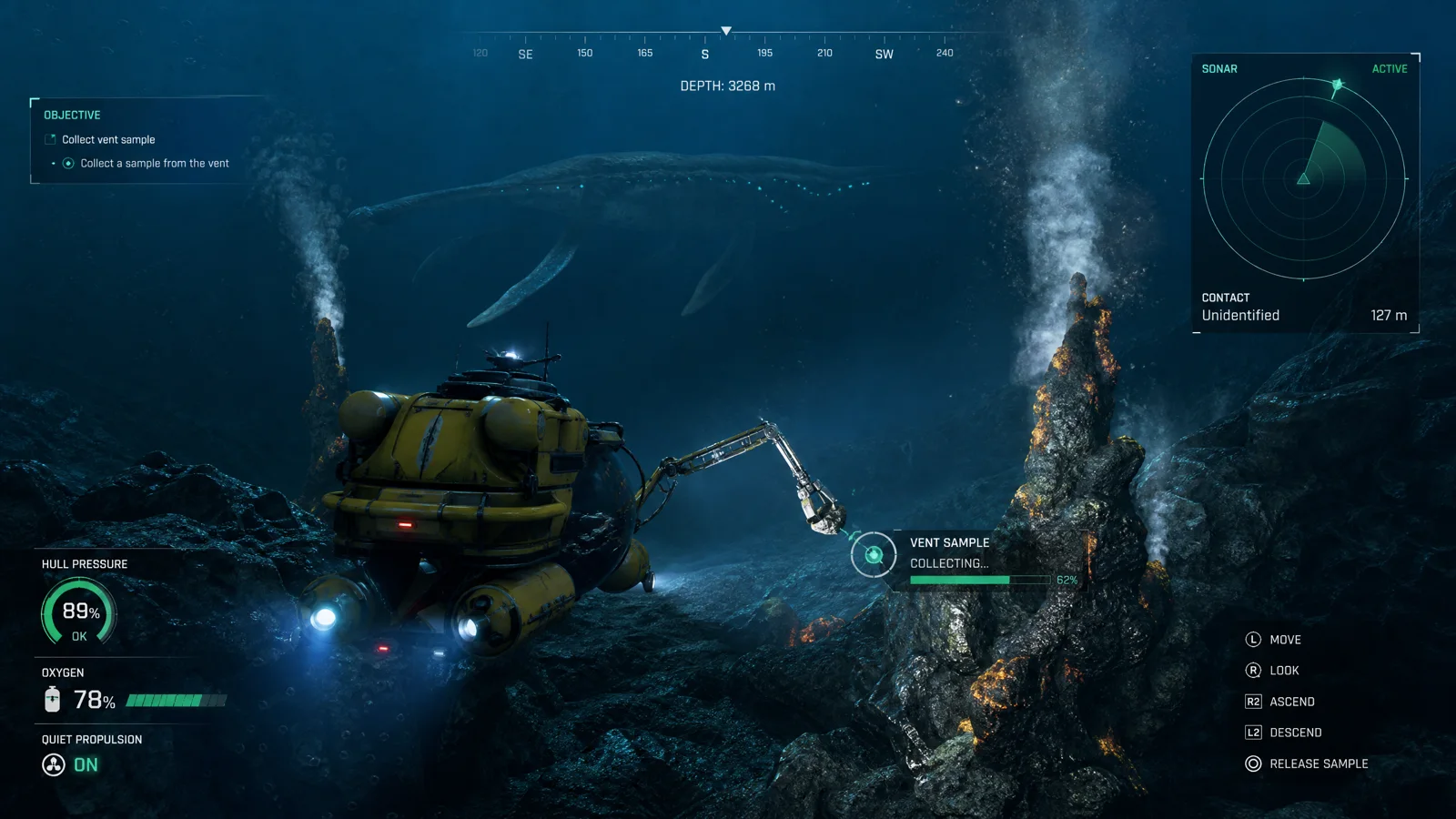
In an industry often obsessed with giving players the biggest guns and the loudest explosions, Deep Current takes a decidedly different approach. It asks you to descend into the crushing darkness of the ocean floor in a fragile yellow research submersible, armed with nothing but scientific curiosity and a suite of delicate sensors. It is a game where patient observation generates far more tension than any firefight, proving that the unknown depths hold wonders and terrors that weapons could never conquer.
The Rhythm of the Deep
The fundamental rhythm of Deep Current is one of preparation, descent, and tense discovery. You begin each expedition aboard your surface support vessel, reviewing your research priorities and outfitting your sub for the specific challenges of the dive. Once you breach the surface and begin your descent, the game shifts into a methodical, almost meditative state. Your primary goal isn't to conquer the abyss, but to understand it.
As you pilot your yellow submersible down past volcanic vents and into uncharted trenches, you are constantly balancing your desire for discovery against the harsh realities of the environment. Every dive is a calculated risk. Do you push deeper to scan that anomalous biological reading, or do you return to the surface before your oxygen reserves dip into the red? This core loop is incredibly satisfying, rewarding those who take the time to properly map their surroundings and respect the hostile nature of the ocean floor. It is a brilliant execution of risk versus reward, where the currency is scientific data and the penalty is a lonely, crushing end.
Systems Under Pressure
Piloting the submersible feels appropriately weighty and deliberate. You aren't flying a nimble fighter jet; you are coaxing a heavy metal sphere through a dense medium. The control scheme demands finesse, especially when holding your position against deep-sea currents to operate the sample arm. Gathering specimens requires a delicate touch, and the tactile feedback makes every extraction feel like a genuine achievement.
Resource management is where the game's true tension lies. You must constantly monitor your hull pressure, oxygen levels, and battery life. Pushing beyond your depth rating results in terrifying groans from the metal, a brilliant auditory cue that you are flirting with disaster. Moving silently is often essential when massive creatures glide past in the distance. The choice between noisy main thrusters and quiet propulsion to avoid attracting unwanted attention is a constant, nerve-wracking calculation.
- Hull Pressure: Pushing past your depth limit damages the sub and limits your mobility.
- Oxygen Management: A hard limit on your dive time that forces careful route planning.
- Quiet Propulsion: Essential for sneaking past the ocean's more colossal inhabitants.
- Sample Arm: Requires precise analogue stick movements to harvest delicate flora and fauna.
Mapping the Abyss
The environments in Deep Current are spectacular, blending grounded marine geology with a touch of the alien. You are actively charting the unknown using your sonar mapping tools. The sonar ping is your lifeline, briefly illuminating the pitch-black waters and revealing the jagged outlines of volcanic vents and labyrinthine cave systems. The way the map fills out as you explore is immensely satisfying, turning a terrifying void into a known quantity.
Mission design cleverly guides you through these environments without feeling overly prescriptive. Your research priorities might ask you to track migration patterns or take temperature readings near active thermal vents. These objectives encourage you to engage with the environment organically. You might stumble upon a massive shadow moving just beyond the reach of your headlights while looking for a simple rock sample. The game excels at making you feel small and vulnerable.
Sights and Sounds of the Deep
If there is one area where Deep Current truly shines, it is the atmosphere. The visual design is phenomenal, particularly the use of light and shadow. The harsh glare of your floodlights cutting through the murky water creates a claustrophobic cone of visibility. When a massive creature passes in the distance, you often only see a silhouette, which is far more terrifying than a clear view. The volcanic vents are a highlight, spewing superheated water that distorts your vision.
The audio design is equally brilliant. The constant hum of water pressure, the rhythmic ping of your sonar, and the metallic groans of your hull create a soundscape that is isolating and deeply immersive. When you cut your engines to use quiet propulsion, the sudden absence of mechanical noise makes the distant calls of unseen leviathans all the more unsettling. It is a masterclass in using audio to build tension without relying on cheap jump scares.
The Highs and Lows
What works best in Deep Current is its unwavering commitment to its premise. It never compromises its vision of patient exploration by throwing in combat sequences. The tension is entirely systemic, born from the fragility of your craft and the harshness of the environment. The sense of discovery when you finally map a complex trench or successfully retrieve a rare sample is incredibly rewarding, making the slow gameplay feel entirely justified.
However, the experience isn't completely flawless. The pacing can occasionally dip from methodical to sluggish, particularly during long ascents back to the surface vessel. While the initial journey down is fraught with anticipation, the return trip can sometimes feel like busywork. Additionally, the sample arm controls can be a bit too finicky in tight spaces, leading to frustrating moments where your sub gets wedged against a rock wall. A slight adjustment to the collision detection would make these operations smoother.
Final Verdict
Deep Current is a remarkable achievement that proves you don't need weapons to create a thrilling video game. By focusing on scientific observation, resource management, and the sheer, crushing terror of the deep ocean, it delivers an experience that is both uniquely stressful and deeply rewarding. Piloting your fragile yellow submersible through the abyss is a test of nerve and patience, and the game respects its audience enough to let the atmosphere do the heavy lifting.
While the pacing can occasionally falter during routine ascents and the mechanical arm requires a saint's patience, these are minor gripes in the grand scheme of things. For those who are keen on a game that rewards careful planning and respects the terrifying majesty of the natural world, this is an absolute must-play. It is a brilliant reminder that sometimes, the most intense moments in gaming come not from pulling a trigger, but from watching a colossal shadow glide silently through the dark.