
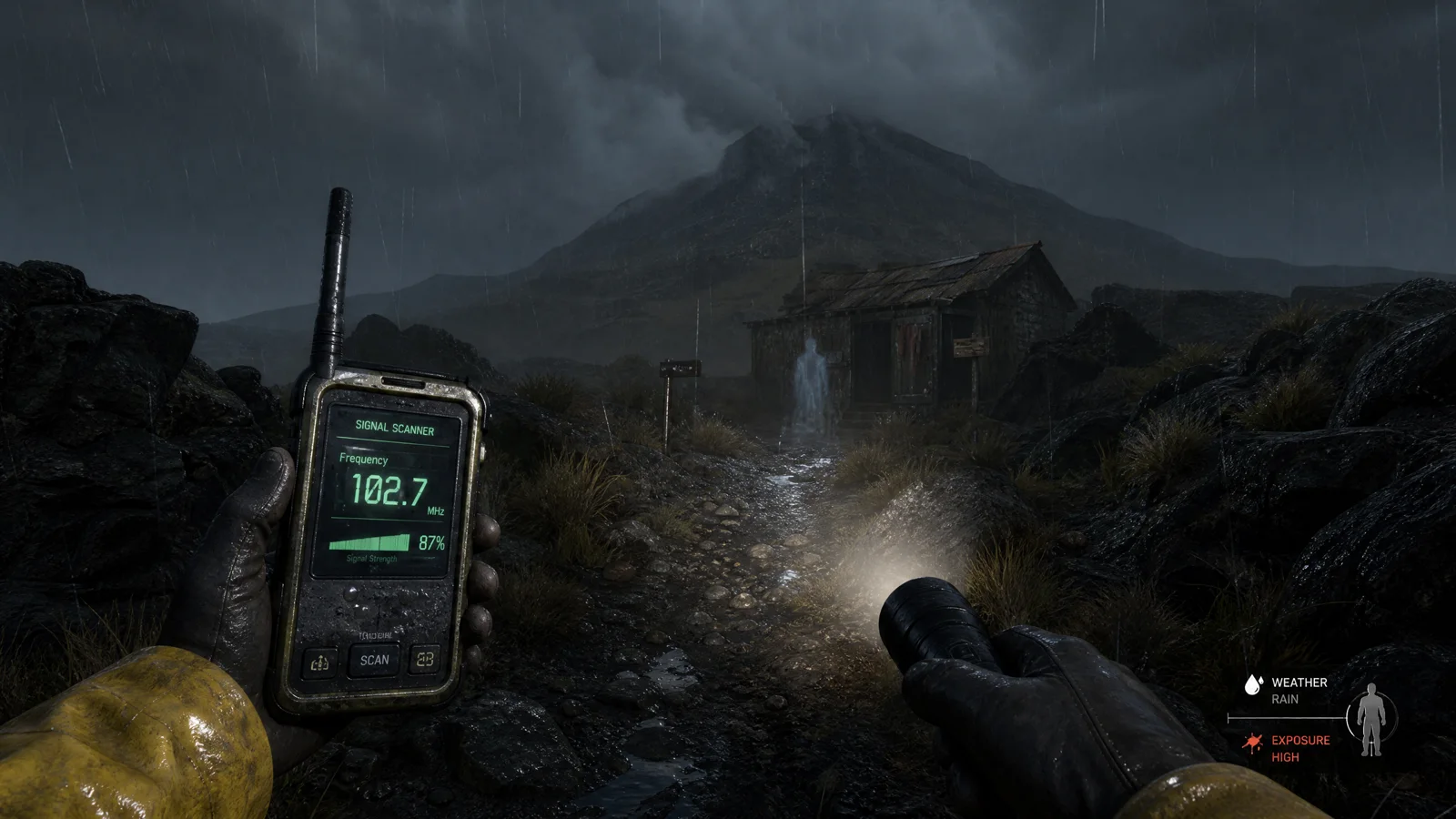
There is a profound silence that settles over the bush just before a heavy storm breaks, a stillness that feels heavy with anticipation. Echoes of Taranaki: A Mountain That Listens Back captures this exact feeling, stretching it into a ten-hour first-person exploration experience that trades cheap jump scares for creeping, atmospheric dread. Set against the looming silhouette of one of New Zealand's most iconic stratovolcanoes, the game places you in the boots of a lone surveyor. By focusing entirely on restrained supernatural systems and demanding absolute respect for the rugged volcanic environment, this title proves that true tension doesn't need constant combat—it just needs a mountain that remembers you, and a dark track that seems to stretch on forever.
The Core Loop: Tracking the Unseen
At its heart, Echoes of Taranaki is a game about acute observation and careful deduction rather than straightforward confrontation. You play as a lone researcher equipped with a bulky handheld scanner, a heavy-duty torch, and a waterproof notebook, tasked with mapping anomalous signal fluctuations along the winding tracks of Mount Taranaki. The core gameplay loop revolves around the meticulous process of signal triangulation. You venture out from your rudimentary base camp, using your scanner's directional audio cues and visual telemetry to pinpoint invisible broadcast nodes scattered across the treacherous volcanic slopes.
Triangulating a signal requires genuine patience and strategic positioning. You must establish three distinct lines of sight to a source, logging the coordinates while navigating loose scree slopes and dense podocarp forest. The true tension stems directly from the game's strict apparition rules: the longer you spend actively scanning, the more the mountain reacts to your presence. The ghosts of the mountain—shifting, semi-translucent figures tethered to abandoned tramping huts—are magnetically drawn to your equipment's high frequencies. When an apparition manifests, usually spotted just at the edge of your torchlight lingering by a weathered wooden doorway, your only defense is to immediately kill your electronics, stand perfectly still in the freezing dark, and wait for the entity to lose interest.
Systems and Survival: Exposure on the Track
Surviving the expedition requires significantly more than just dodging phantoms in the dark; you must also actively manage your exposure to the harsh, unpredictable New Zealand alpine weather. The weather exposure system is punishingly realistic and deeply integrated into the gameplay. A clear morning can rapidly deteriorate into a howling southerly gale, drastically reducing your visibility to mere meters and plummeting your core body temperature. If you get caught out in the open without finding shelter beneath a rocky outcrop or inside a dilapidated backcountry hut, your fine motor controls become sluggish. Your scanner shakes violently in your hands, making triangulation nearly impossible, and your torch beam wavers unreliably.
The game's non-linear field notes system is your primary tool for navigating both the physical terrain and the supernatural hazards. Rather than spoon-feeding you a linear narrative through cutscenes, the game scatters fragments of lore, old geological surveys, and frantic diary entries from previous expeditions across the massive map. You have to physically piece these clues together in your journal, drawing logical connections between specific weather patterns and the appearance of certain apparitions. Learning that a particular weeping ghost only walks the track during heavy rain, or that a specific radio frequency can temporarily repel an aggressive entity, feels incredibly rewarding.
Level Design: A Mountain of Memories
The mountain itself is the undisputed star of the entire experience. The level design brilliantly captures the rugged, unforgiving verticality of the Taranaki landscape. The map is a seamlessly interconnected web of overgrown walking tracks, steep ridges, and deep gorges. The environment is designed to be deliberately disorienting; the dense native bush looks identical from multiple angles, forcing you to rely on natural landmarks, the slope of the land, and your trusty compass rather than a magical minimap.
The scattered, abandoned tramping huts serve as vital anchors in this deeply hostile geography. These small, rusted corrugated iron shelters offer temporary respite from the biting wind and a crucial place to warm up, but they are also intense focal points for supernatural activity. The juxtaposition of finally finding a safe haven, only to turn around and see a distorted figure illuminated by your torchlight standing right outside the frosted window, is masterfully executed.
Sensory Feedback: The Mountain Speaks
Where Echoes of Taranaki truly excels is in its phenomenal environmental audio and visual feedback. The game relies heavily on its soundscape to communicate unseen threat levels and signal proximity. The satisfying crunch of your heavy boots on volcanic gravel, the sharp snapping of a dry twig in the distance, and the low hum of your scanner are rendered with stunning spatial clarity. When an apparition draws near, the comforting ambient noise of the forest suddenly drops away, replaced by a localized silence that makes the hairs on the back of your neck stand up in genuine alarm.
What Works and What Stumbles
The sheer restraint shown by the developers is undoubtedly the game's greatest asset. By completely denying the player conventional weapons and relying entirely on evasion and environmental awareness, every single encounter feels meaningful and terrifying. The core mechanics interlock beautifully; the urgent need to scan directly conflicts with the desperate need to stay hidden, and the dynamic weather system forces you to make risky pushes for shelter.
However, the experience is not without its frustrating rough edges that can occasionally pull you out of the immersion.
- The non-linear field notes system, while deeply rewarding, can occasionally lead to frustrating progression blockers if you miss a single piece of paper hidden in a dark corner.
- The penalty for freezing to death out in the elements—being unceremoniously sent all the way back to your last base camp—can feel overly punishing and disrespectful of your time.
- Some of the steeper track sections suffer from slightly clunky collision detection, leading to immersion-breaking moments where you get stuck on a knee-high rock.
Final Verdict
Echoes of Taranaki: A Mountain That Listens Back is a gripping, deeply atmospheric triumph that truly understands the psychological power of the unseen. It leverages its distinct New Zealand setting to create a world that feels both authentically grounded and profoundly hostile. The intertwining mechanics of careful signal triangulation, desperate weather survival, and strict apparition avoidance blend into a cohesive, nerve-wracking experience that will stick with you long after you've finally turned off your torch. While it demands significant patience and a genuine willingness to engage with its cryptic narrative puzzle pieces, those who are brave enough to walk the track will find one of the most compelling, uniquely combat-free horror experiences of the entire year. It is a stark reminder that sometimes, the absolute most terrifying thing you can do in a video game is just stand perfectly still in the dark and listen.