
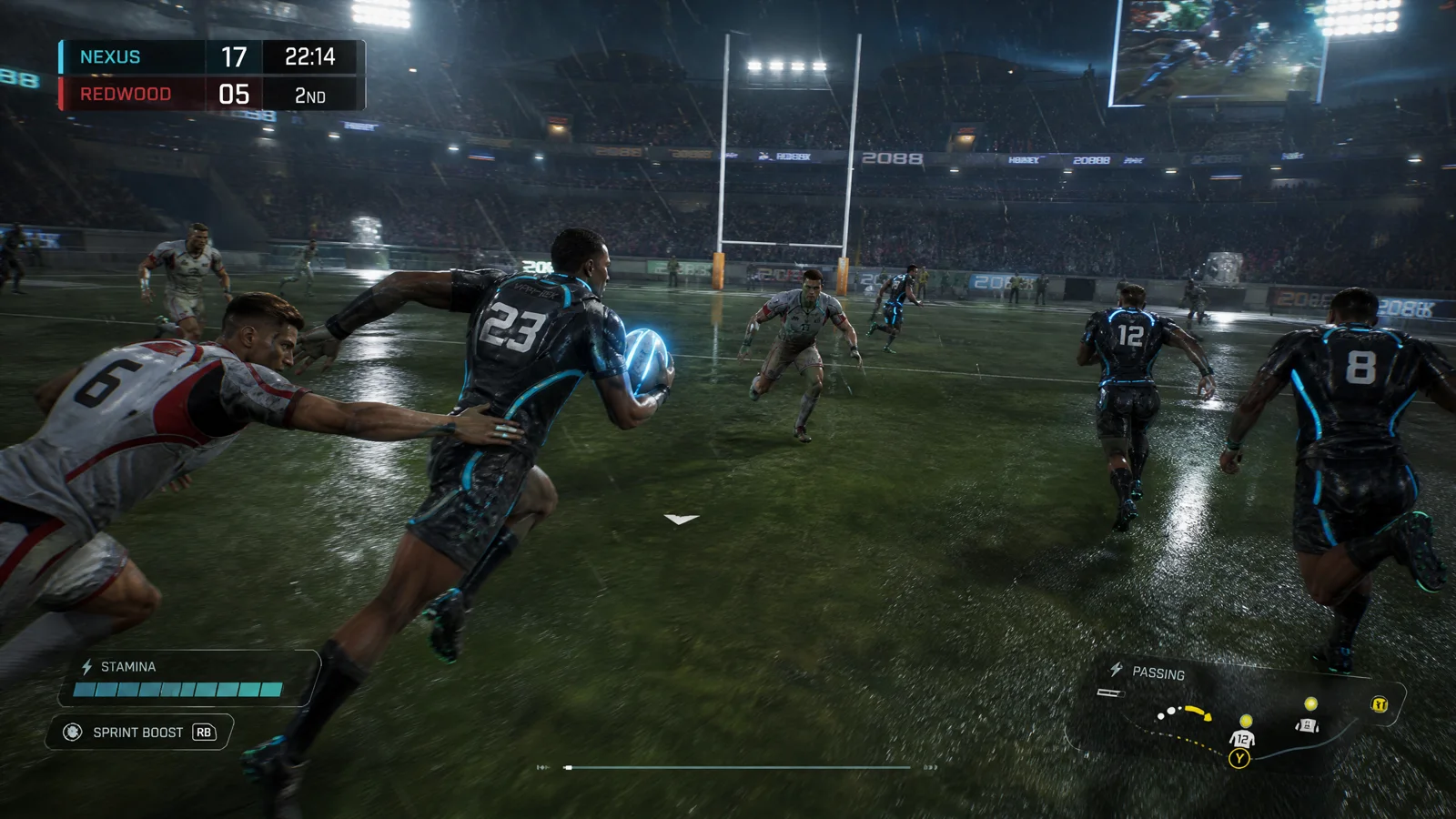
Rift Rugby 2088 sprints onto the paddock like a winger with rocket boots, all chrome edges and rain-slick lights. It’s fast, flashy, and surprisingly thoughtful. Beneath the neon and the humming energy ball sits a sharp, position-first rugby brain. The future, it turns out, still rewards a clean pass, a smart line, and a bit of hard yakka when the ruck gets messy.
Core Loop and Pace
The core loop mixes arcade pace with deliberate patterns. Possession starts with a zip from the kicker or a quick feed from a synthetic-voiced ref, then you’re finding passing lanes that glow faintly as runners angle for space. Holding the ball too long invites momentum tackles that hit like trucks; shift it early and you’ll bend the defensive line. Each phase asks the same question: tip-on to the shoulder, or skip to the wing and risk an intercept? Short tactical rewinds, limited to a few seconds and a tight charge meter, let you bite back a blunder without breaking the match flow. Use one to replay a mistimed cut-out, re-time the pass, and you’ll feel like a genius. Waste it, and you’re out of mulligans when the try-line looms.
Positional play matters more than brute inputs. Your forwards set pods automatically from preselected formations, giving you a platform or a decoy, while backs shape into wide diamonds that emphasise depth. The game rewards holding width and straightening late; angle in too soon and support runners fall behind, starving you of offload options. When a tackle lands, momentum and body height determine who owns the ruck. Drive through on green timing and you’ll secure lightning-quick ball; mistime and you’re trapped, coughing up a turnover under advantage. Kicks are viable circuit breakers, but the ball’s energy core skids wickedly on the wet turf, so chasing lines and bounce reads are part of the dance.
Controls and Systems
The control scheme is tidy and forgiving without feeling shallow. Left stick steers, right stick feathers acceleration and side-steps, while a dedicated pass button traces to the highlighted lane. Hold to arc a longer skip; a gentle tap gives you that quick pop to a pod. The HUD earns its keep: stamina rings sit under each carrier’s boots, fading from fern-green to warning amber, and a tiny arrow shows their current support line. You can toggle passing lane highlights to “pro”, where they only flash when the receiver is actually onside and square, which keeps things honest. Momentum tackles live on a pressure trigger; squeeze as you meet the runner and the hit scales with your speed differential, not just stats, so timing and angle trump button mashing.
Formations and set plays sit on the d-pad, and they’re context-sensitive. Call “Diamond Wide” and your 10 drops a step, wings pinch in, and you’ll see new lanes open. Flick to “Crash Pod” and the closest forward trio forms up for a battering ram with an auto-clean if you hit contact on plan. Stamina is more than window dressing; tired players lose hips, making them late to tackle or slow to fold, so rotating with quick subs is key in longer matches. The rewind sits on a bumper with a clear charge pip, and its footprint is tiny—about three seconds—so you can’t cheese a whole movement, just correct a timing blunder. It’s sweet as for learning lines without killing the pace.
Stadiums, Pitch, and Presentation
The stadiums feel like tomorrow’s cathedrals. Under floodlights the wet pitches gleam, rain beading on synthetic grass and pooling in sideline drains. When your carrier hits top speed, the energy ball throbs brighter and leaves a faint ion trail, a handy read on velocity that also looks cool as. Contact splashes spray up in sheets, and heavier momentum tackles carve slide marks you can still see at the next phase, a subtle cue about where bodies have been.
Presentation keeps the speed legible. The sports HUD is restrained, with score, phase count, wind, and stamina all sitting on a single unobtrusive bar. A tiny triangle points to the first receiver, and colour-coded lines indicate advantage or offside in plain language, not jargon. Audio is slick: the ball hum changes pitch when it’s low on charge after heavy contact, boots squeak on the damp surface, and the ref’s calls are clear without drowning the thump of a big shot. Cameras hold a slightly elevated sideline angle that widens automatically on breaks, and snap tighter for scrums and penalties. In a storm, droplets streak across the lens, but never hide the pass window.
What Works
Rift Rugby 2088 shines when it balances style with structure. The design nudges you toward heads-up rugby while still letting you cut loose. These elements in particular clicked from the first kick-off.
- Responsive passing lanes that teach timing.
- Momentum tackles that reward angle and bravery.
- Stamina cues that drive smart rotations.
- Formations creating natural depth without fuss.
- Rewinds that train reads, not cheese.
Together they make a nimble loop that’s easy to learn, hard to master, and endlessly replayable.
What Needs Improvement
For all the polish, a few edges had me gutted. Intercepts are a tad sticky on higher difficulty, triggering even when the lane highlight says safe, which undercuts trust. Ruck detection sometimes misreads a dominant carry as held-up, stalling quick ball. Lineout calls feel undercooked, with limited variation and floaty throws that don’t reflect momentum physics. The rewind meter also drains on kick feints, which seems harsh for a non-committal action.
Verdict
Rift Rugby 2088 threads the needle between arcade swagger and genuine footy nous. It’s quick, readable, and happiest when you’re thinking two passes ahead. Some systems need tightening, but the foundations are rock solid. If the future plays like this, I’m stoked. On today’s form right now, it earns a confident 8.6 out of 10.